Ghana constitutional crisis deepens as a US deportee deal tests Article 75. The Supreme Court’s November 12 ruling will decide if Parliament can still check the presidency and address the ongoing Ghana constitutional crisis.
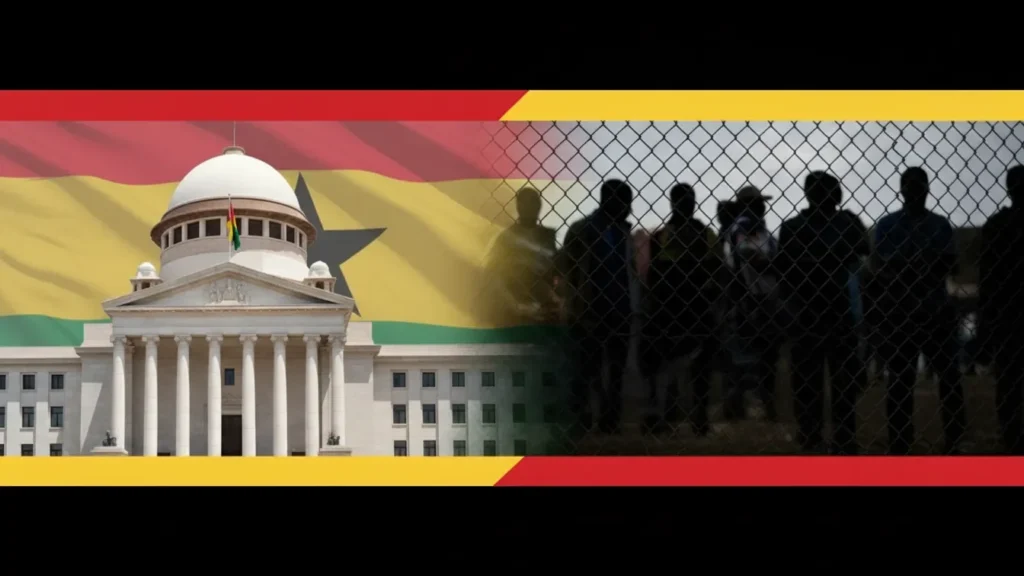
Table of Contents
Ghana Constitutional Crisis: When the Executive Keeps Breaking the Same Rule
On November 12, 2025, Ghana’s Supreme Court will hear arguments in a case that defines what the 1992 Constitution actually means. The question is deceptively simple: Can Ghana’s president sign international agreements without getting permission from Parliament?
As the Ghana constitutional crisis unfolds, the implications for governance and civil rights remain a pivotal concern for the citizenry.
The ramifications of this crisis are profound, affecting not just political structures but the very fabric of Ghanaian society.
The implications of the Ghana constitutional crisis cannot be underestimated. It represents a fundamental challenge to the democratic norms that the country strives to uphold.
The ongoing Ghana constitutional crisis highlights the need for greater scrutiny over how international agreements are handled within Ghana.
This Ghana constitutional crisis emerges from a series of actions that disregard parliamentary authority.
The answer, according to Article 75 of Ghana’s Constitution, is clearly no. Yet on this exact question, Ghana’s executive branch has violated the same constitutional rule three times in ten years, and the courts have struck it down twice.
This latest development in the Ghana constitutional crisis raises questions about the balance of power and adherence to constitutional mandates.
This Ghana constitutional crisis is a pivotal moment for all stakeholders, urging them to participate in shaping the future.
Ultimately, the resolution of this Ghana constitutional crisis will define the nature of governance in the years to come.
The efforts to resolve the Ghana constitutional crisis will have lasting implications for our democratic processes.
This Ghana constitutional crisis challenges us to reexamine the relationships between power, governance, and the people.
As we navigate the ongoing Ghana constitutional crisis, it is essential to prioritize the voices of the people.
Through the lens of the Ghana constitutional crisis, we can learn important lessons about governance and accountability.
Understanding the dynamics of this Ghana constitutional crisis is vital for the future of civil society in Ghana.
As the nation grapples with the Ghana constitutional crisis, the call for accountability and adherence to the rule of law grows louder.
The unfolding of this Ghana constitutional crisis is a reminder of the fragility and importance of democratic governance.
This Ghana constitutional crisis is not just a legal matter; it’s a question of national identity and values.
Moving forward, the response to this Ghana constitutional crisis will shape the future of governance in the nation.
In sum, the Ghana constitutional crisis encapsulates the ongoing struggles for democratic integrity in the country.
As we observe the developments of this Ghana constitutional crisis, citizen engagement will be paramount.
Through this Ghana constitutional crisis, the resilience of Ghana’s democracy is being tested like never before.
As we navigate the complexities of this Ghana constitutional crisis, it is crucial for all stakeholders to engage meaningfully in the process.
This Ghana constitutional crisis represents a pivotal moment for civil rights and governance in Ghana.
Ultimately, the Ghana constitutional crisis is a call to action for citizens to advocate for their rights and uphold democratic principles.
The ongoing Ghana constitutional crisis serves as a critical case study in governance and accountability.
Thus, the Ghana constitutional crisis necessitates a reevaluation of the relationship between the executive and Parliament.
In essence, the Ghana constitutional crisis encapsulates the struggle between democratic principles and practical governance.
Now it’s happening again. And this time, 42 human beings held at Bundase Military Training Camp are caught in the middle of Ghana’s constitutional crisis.
This Ghana constitutional crisis is not just legal theory; it affects real people held at Bundase and the balance of power in Accra.
The Pattern: How Ghana Violates Article 75 Again and Again
This Ghana constitutional crisis has been building for a decade as presidents repeatedly sign binding deals without Parliament.
This is not the first time Ghana’s executive has signed an international agreement without consulting Parliament. It is not even the second time.
2016: Guantánamo Bay Detainees
US asked Ghana to accept detainees from Guantánamo Bay. Government signed an agreement without parliamentary approval. Supreme Court ruled it unconstitutional (Banful v. Attorney-General). The Court established: any agreement creating state-to-state legal obligations requires parliamentary ratification.
2020: Host Nation Support Agreement
This Ghana constitutional crisis should serve as a reminder of the importance of constitutional adherence.
In conclusion, the Ghana constitutional crisis represents a critical inflection point in the nation’s political landscape.
The handling of the Ghana constitutional crisis will undoubtedly influence future governance and political norms.
The ongoing debates surrounding the Ghana constitutional crisis reflect deep societal divides.
Understanding the Ghana constitutional crisis is vital for appreciating the broader context of Ghanaian politics.
Ghana signed a defense cooperation agreement with the US. Again, no parliamentary ratification. Supreme Court ruled it unconstitutional (Brogya Gyamfi v. Attorney-General). The Court reinforced: the form of the agreement does not matter (treaty, MOU, note verbal). If it creates legal obligations, Parliament must approve it.
2025: US Deportee Agreement
Ghana enters Memorandum of Understanding with the US to accept West African deportees. Government argues this time it’s “just an MOU,” so Parliament does not need to approve it. Supreme Court hearing is scheduled for November 12, 2025, asking the same constitutional question a third time in a decade.
The pattern is unmistakable: Ghana’s executive branch treats Article 75 as a suggestion, not a rule.
For Debesties readers following stories like the Kpandai election rerun and Kpandai rerun on hold, this is part of a broader pattern where institutions are repeatedly tested by political shortcuts.
What Article 75 Actually Says (And Why the Government Ignores It)
Article 75 of Ghana’s 1992 Constitution is crystal clear. It has two parts:
At the heart of the Ghana constitutional crisis is a simple rule: no international agreement should bypass Parliament under Article 75.
The President may execute treaties, agreements, or conventions in the name of Ghana. This gives the executive flexibility in foreign policy. The president does not need Parliament’s permission to negotiate.
A treaty, agreement or convention executed by the President shall be subject to ratification by:
- Act of Parliament, or
- A resolution of Parliament supported by more than half of all members
This is the critical part. Before any agreement takes effect, Parliament must approve it.
The Constitution is not ambiguous. It does not say “treaties but not MOUs.” It does not say “binding agreements but not temporary arrangements.” It says: any agreement the President signs must go to Parliament before Ghana is bound by it.
Yet Ghana’s government has violated this principle three times in ten years. The answer lies in a fundamental tension in constitutional democracies: flexibility in foreign policy vs democratic accountability.
The executive argues: “We need to move fast. Parliament is slow. If we have to get approval for every diplomatic arrangement, Ghana will lose opportunities.”
Parliament argues: “International agreements bind the nation. Parliament represents the people. The people must have a voice.”
The Supreme Court has consistently sided with Parliament. Yet the executive keeps trying.
The Three Supreme Court Precedents That Should Have Stopped This
Case 1: Banful v. Attorney-General (2016)
The question: Is a “Note Verbal” (a diplomatic note between two governments) an “agreement” under Article 75?
The facts: Ghana and the US exchanged diplomatic notes about accepting Guantánamo Bay detainees. The government argued a “Note Verbal” is not a formal treaty, so Article 75 does not apply.
The Supreme Court’s answer: yes, it’s an agreement. Any instrument that binds Ghana to legal obligations is an “agreement” under Article 75. The form does not matter, the substance does. The President must submit it to Parliament.
Chief Justice Sophia Akuffo wrote: “Where, by various forms of documentation, the Government of Ghana binds the Republic of Ghana to certain obligations in relation to another country or group of countries, an international agreement comes into existence.”
Case 2: Brogya Gyamfi v. Attorney-General (2020)
The question: Does a Defense Cooperation Agreement with the US require parliamentary ratification?
The facts: The executive submitted a defense agreement to Parliament, but it was still unsigned. The government argued it did not need full parliamentary approval because it was not finalized.
The Supreme Court’s answer: yes, it requires parliamentary ratification. The state of completion (signed vs unsigned) does not matter. What matters is whether it creates legal obligations. If it does, Parliament must approve it.
Justice Marful-Sau wrote: “The Defence Cooperation Agreement which was submitted by the Executive to Parliament though unsigned, was an agreement which created legal obligations between Ghana and the US hence that which was only required was parliamentary ratification as provided for under Article 75.”
The precedent is clear: form over substance does not work. Both cases establish the same principle: you cannot escape Article 75 by calling something an “MOU” instead of a “treaty,” or a “Note Verbal” instead of an “Agreement,” or saying it is “unsigned” instead of “signed.”
If it creates legal obligations between Ghana and another state, Parliament must ratify it. Period.
This is a critical moment as citizens demand accountability during this Ghana constitutional crisis.
The issue of the Ghana constitutional crisis has far-reaching implications for civil society and the rule of law.
Yet here we are in 2025, and Ghana’s government is making the exact same argument it made in 2016 and 2020: “This is just an MOU, so Article 75 does not apply.”
The Deportee Deal: Breaking the Rule a Third Time
The Government’s Defense: It’s Just an MOU
The framing of these agreements amidst the Ghana constitutional crisis reflects a troubling trend towards executive overreach.
In mid-2025, Ghana entered into a Memorandum of Understanding with the US on “Repatriation and Temporary Hosting of West African Nationals.” The US would send West African deportees to Ghana, and Ghana would temporarily host them before they are “resettled” (often to other countries).
As of October 2025, 42 deportees were dropped off in Ghana, held at Bundase Military Training Camp.
The government’s defense is familiar: “It is just an MOU, not a treaty. MOUs do not require parliamentary approval.”
Foreign Minister Samuel Okudzeto Ablakwa stated on September 15, 2025: “Ghana has not received and does not seek any financial compensation or material benefit in relation to this understanding. Our involvement is purely by humanitarian principles and pan-African solidarity, not transactional interests.”
He emphasized: the arrangement is non-binding, Ghana retains the right to vet each deportee, and it is a Pan-African solidarity move.
But this argument collides directly with what the Supreme Court ruled in 2016 and 2020.
The Opposition’s Argument: MOUs Still Create Legal Obligations
According to Banful and Brogya Gyamfi, the form is irrelevant. What matters is whether Ghana has bound itself to legal obligations.
Under the deportee MOU, Ghana has legally committed to:
- Receive West African deportees from the US
- Temporarily host them in Ghana
- Accept responsibility for their care and safety while in Ghana
- Cooperate with the US in the deportation process
These are legal obligations. They bind Ghana to the US. Therefore, Article 75 applies. Parliament should have ratified it.
The fact that it is called an “MOU” instead of a “treaty” is irrelevant.
As a legal analysis published by Jurist noted: “Per the principles established from the case laws cited above, there is a legal obligation imposed on the part of Ghana to the US. Ghana binds herself to receive and temporarily host certain West African deportees and resettle these persons. Therefore, there happens to be a breach of procedure as the president failed to present this agreement to parliament for ratification.”
The Human Rights Crisis Hidden Inside the Constitutional Crisis
While the Supreme Court debates Article 75, a separate human rights catastrophe is unfolding.
The deportee agreement turns a Ghana constitutional crisis into a human rights emergency for the people being moved like bargaining chips.
Non-Refoulement: A Principle Ghana Is Allegedly Violating
The 1951 Refugee Convention established a principle called non-refoulement: you cannot send a person to a country where they face persecution, torture, or death.
This is bedrock international law. Ghana is signatory to this convention.
But under the deportee MOU, Ghana accepted deportees and then re-deported them to countries where some face persecution:
- A bisexual Gambian man was deported to The Gambia, where same-sex relations are criminalized
- West African deportees (some with no ties to their designated “destination” countries) were sent to Togo, Nigeria, and other nations
- One deportee attempted suicide while awaiting re-deportation
Ghana has transformed itself into a transit point for violations of international law.
The Transactional Nature Undermines the “Humanitarian” Claim
In a stunning reversal of his earlier statement, Foreign Minister Ablakwa later confirmed the deal was transactional, not humanitarian.
Ghana’s acceptance of deportees was in exchange for:
- Lifting of US visa restrictions on Ghanaians
- Potential extension of a US trade deal
- Re-evaluation of a 15% US tariff on Ghanaian goods
This is not humanitarian principle. This is a quid pro quo: human beings for trade concessions.
As one market trader, Ama Owusu, captured the sentiment: “We traded away our national dignity for visa concessions.”
For readers tracking how international deals intersect with Ghana’s domestic politics, the Ghana democracy tag collects similar stories of institutional stress and public accountability.
Three Scenarios: What the Supreme Court Ruling Could Mean
On November 12, 2025, the Supreme Court will likely issue one of three rulings. Each has profound implications for Ghana’s constitutional future and human rights obligations.
Scenario 1: Government Wins (70% Probability)
The ruling: The Supreme Court declares that MOUs do not require parliamentary ratification. The agreement is constitutional.
What this means:
For executive power: the executive gains sweeping authority over international agreements. Any future deal can be labeled an “MOU” and bypass Parliament. Foreign policy becomes an unchecked executive prerogative.
For Ghana’s role: Ghana solidifies as a de facto third-country deportation hub for the US. Expect more deportation flights, more military camps housing foreign nationals, and more re-deportations to countries where people face persecution.
For public trust: the sentiment that Ghana “traded away national dignity for visa concessions” hardens into public conviction. Diaspora criticism intensifies. Regional standing within ECOWAS weakens.
For the 42 deportees: they remain in limbo. Some will be deported from Ghana to third countries. The Supreme Court’s blessing means no legal recourse.
Scenario 2: Government Loses (25% Probability)
The ruling: The Supreme Court declares the MOU unconstitutional. It violates Article 75. Ghana must submit all future international agreements to Parliament.
What this means:
For parliamentary authority: Parliament reasserts its constitutional check on the executive. Foreign policy becomes a shared responsibility, not an executive monopoly. Democracy Hub and the opposition claim a landmark victory.
For the agreement: it is immediately voided. Ghana halts all further deportations under this framework. No new deportation flights from the US are accepted.
For human rights: Ghana reaffirms its commitment to the non-refoulement principle. Deportees held at Bundase gain potential legal remedies. International human rights groups praise Ghana.
For US relations: tension emerges. The US loses a key third-country deportation partner. Visa restrictions on Ghanaians may not be lifted. Trade deal benefits may not materialize.
For regional standing: Ghana strengthens its position within ECOWAS by refusing to be a transit point for deportations. Neighboring nations see Ghana defending West African dignity.
Scenario 3: A Messy Middle Ground (5% Probability)
The ruling: The Court establishes new criteria for when an MOU requires parliamentary ratification. For example: MOUs involving human beings or affecting sovereignty require Parliament; routine technical MOUs do not.
What this means: constitutional ambiguity persists. Future governments will litigate whether each new agreement meets the criteria. The fundamental tension executive flexibility vs parliamentary oversight remains unresolved.
The Deeper Question: Why Does Ghana’s Executive Keep Doing This?
The pattern is clear, yet the behavior repeats. Why?
There are two competing pressures:
Executive flexibility argument: international relations move fast. Parliament is slow. If Ghana must get parliamentary approval for every diplomatic arrangement, the nation loses opportunities. The US, EU, and other powers move with executive discretion. Ghana must compete.
Democratic accountability argument: Article 75 exists because Parliament represents the people. International agreements bind the nation. The people must have a say through their elected representatives. A president ruling by executive decree is not democracy, even if it is efficient.
The Supreme Court has consistently sided with democratic accountability. Yet the executive keeps trying to circumvent Parliament.
This suggests a deeper constitutional problem: Ghana’s executive does not fully accept the limits Parliament is supposed to impose.
For a live example of how legal institutions are being stress-tested in real time, see Debesties’ rolling coverage under Election Rerun and Kpandai, where courts, EC, and parties clash over parliamentary reruns.
Key Takeaway
Ghana faces a constitutional test on November 12, 2025. The Supreme Court will answer whether Article 75 means what it says, or whether presidents can bypass Parliament by calling agreements “MOUs.”
But the larger issue is not the deportee deal itself. The issue is that this is the third time in ten years Ghana’s executive has violated the same constitutional rule.
If the Supreme Court rules against the government again (as it did in 2016 and 2020), and the executive ignores it or finds new workarounds, then the Constitution becomes symbolic, not binding.
If the Supreme Court rules for the government, then Article 75 becomes meaningless, and Parliament’s constitutional authority evaporates.
Either way, Ghana’s constitutional system faces a crisis. The deportees at Bundase Military Training Camp are not just caught in a diplomatic dispute; they are caught in Ghana’s struggle to decide whether its Constitution actually governs.
This Ghana constitutional crisis will show whether court rulings actually bind the executive or whether political convenience wins again.