
Ghana floods destroy farms in Kumbungu’s Ni community, wiping out over 300 acres of crops and leaving farming families in desperate debt with no harvest in sight.
Question:
What happened when floods hit farms in Ghana’s Ni community in Kumbungu?
Answer:
Ghana floods destroyed farms across more than 300 acres in the Ni community of Kumbungu District in February 2026, leaving families with no harvest and unpayable debt. The scale of the damage has alarmed climate experts who say Northern Ghana’s food belt is dangerously exposed.
The rains did not come to refresh the land. They came to take everything.
In Kumbungu’s Ni community, over 300 acres of farmland went completely underwater. Families who planted everything they had are now watching their harvest season disappear beneath muddy floodwaters, and the damage stretches far beyond one community.
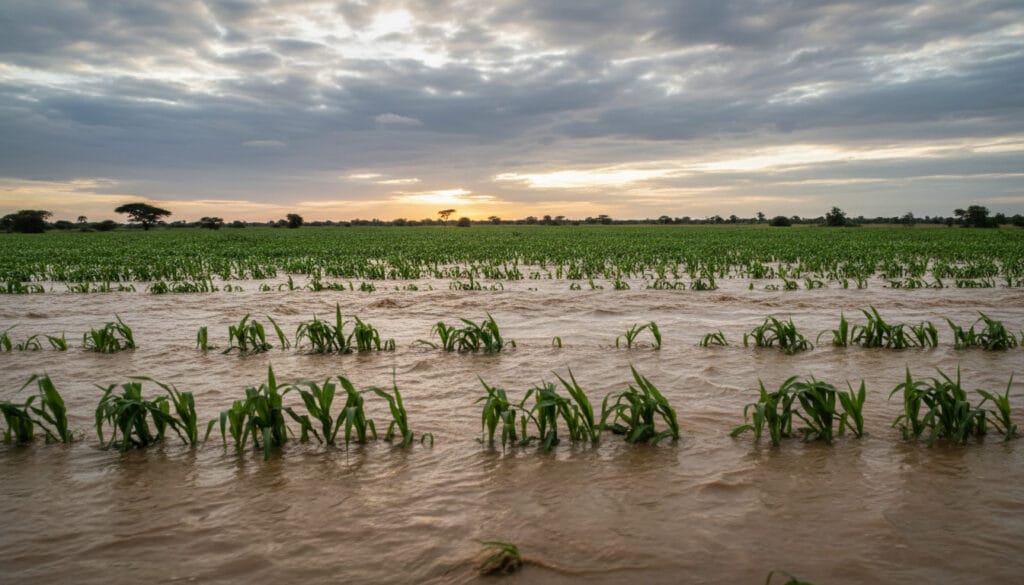
Table of Contents
The Night the Water Rose
On February 19, 2026, severe flooding swept through the Ni community in Kumbungu District of Ghana’s Northern Region. The water moved fast. By the time most families realised what was happening, their fields were already gone.
Farmer Abdul Zakaria, a man in his sixties, lost all 7 acres of his farm in a single night. He had already paid GH¢1,400 in tractor costs alone at GH¢200 per acre. That money is gone with no harvest coming to recover it. His wife watched helplessly as the water rose and covered everything they had worked for that season.
His neighbour Muhammad Hi managed to drag a small portion of his crops out before the fields went completely under. But across the Ni community, the picture is the same. Most farmers lost nearly everything.
What 300 Acres of Loss Actually Means
Numbers on their own can feel distant. Three hundred acres is not just land. It is dozens of households that invested months of work and real money upfront with nothing to show for it now.
Farmers in Northern Ghana operate on credit. They pay for tractors, weedicide, seeds, and hired labour long before any harvest arrives. When a flood wipes a crop out, it does not just erase future income. It turns debt into a hole with no way out. Zakaria’s GH¢1,400 tractor bill is confirmed. The harvest to pay it back no longer exists.
This cycle repeats itself across every affected household, and this season it hit all at once.
Why Ghana Floods Destroy Farms in the North Every Season
This is not bad luck. Climate experts who spoke directly on this story explained the three forces working against farming communities in Northern Ghana every rainy season.
Mahameu, a lecturer from the Faculty of Agriculture and Natural Resources at Tamale Technical University, pointed to prolonged and heavy rainfall overwhelming low-lying land that has poor natural drainage. Add to that the growing habit of building structures within natural waterways, and floodwater has nowhere to go except across farmland.
Deforestation makes everything worse. Trees and ground cover slow water movement and help soil absorb rainfall before it spreads. When that cover disappears, floodwater moves faster, spreads wider, and hits farms harder. You can explore how environmental destruction is reshaping communities across Ghana in our nature coverage on Debesties.
A Food Crisis That Does Not Stay in Kumbungu
Northern Ghana does not just feed Northern Ghana. It feeds the whole country. When floods destroy farms in this region, the damage travels south to every market in Accra, Kumasi, and Tamale.
Climate expert Mr. Wo, who also commented on this disaster, warned directly that repeated flood losses in the north chip away at Ghana’s food security in ways that take years to recover from. Maize, sorghum, and other staple crops grown in the savannah belt become harder to find and more expensive to buy when an entire growing season disappears underwater.
For diaspora Ghanaians watching from abroad, the message is straightforward. Investing in climate-smart agriculture and rural resilience back home is not charity. It is protection for Ghana’s food future. Stories like Kumbungu are exactly why the conversation around Ghana’s nature and sustainability matters so urgently right now.
What Must Happen Now
The immediate need in Kumbungu is relief. Farming households need food support and debt relief before the next planting season arrives or the cycle gets worse.
Beyond emergency help, Mahameu’s recommendation is clear: farming communities in flood-prone zones cannot survive on one crop and one season as their only income. Livelihood diversification is the buffer that keeps a family standing when the rains turn destructive. Local government in the Northern Region, agricultural extension services, and development organisations all have a role to play in building that buffer before the next rainy season hits.
Key Takeaways:
- Ghana floods destroyed over 300 acres of farmland in the Ni community in Kumbungu District on February 19, 2026
- Farmer Abdul Zakaria lost a 7-acre farm and faces GH¢1,400 in tractor debt with zero harvest to recover it
- Climate experts cite prolonged rains, low-lying land, and deforestation as the three compounding causes of worsening flood damage in the North
- Northern Ghana supplies a critical share of Ghana’s staple crops, meaning this loss threatens national food prices and supply
- Experts say livelihood diversification is the most urgent adaptation step for farming communities in flood-exposed areas