

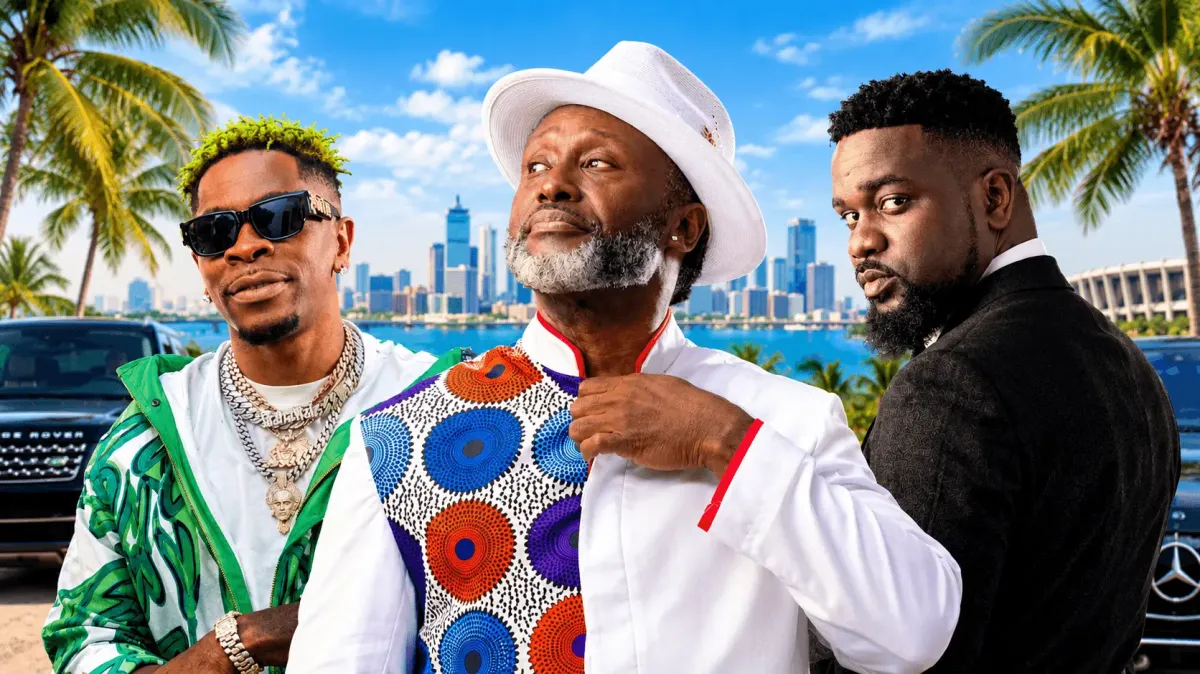
The Ghana music industry connects musicians, songwriters, producers, managers, labels and promoters. Their work takes a song from the studio to radio, streaming platforms and live audiences, while contracts and copyright help determine who controls it and gets paid.
To understand the business, it helps to know the music’s history. Highlife, hiplife and Asakaa emerged in different settings, shaped by performers, producers, technology and the communities around them. This guide explains those connections and the rights and organisations artists need to understand.
How the Ghana Music Industry Works
A recording begins with creative work, but releasing it involves business decisions too. Someone must arrange the recording, agree contributor credits, deliver the release and organise promotion. A label may provide those services, or an independent artist may hire a team and manage the process directly.
The important distinction is between doing a job and owning a right. Producing a recording, financing a video or arranging publicity should not be treated as automatic ownership of every part of the music. The relevant agreements need to explain responsibilities, fees, rights and payment terms.
For readers, the industry is easiest to understand through three connected questions:
How did the music develop?
Who owns and administers the work?
How does it reach listeners and generate income?
Highlife and the Foundations of Ghanaian Popular Music
Highlife is not simply an old genre that newer music replaced. It remains part of Ghanaian social life, heard at weddings, funerals, festivals, naming ceremonies and other gatherings. UNESCO identifies Dance Band, Guitar Band and Burger Highlife as three main styles.
Those styles reflect different instruments, audiences and performance settings. They also show why Ghanaian music history cannot be reduced to one inventor or a single starting date.
Early Guitar Music and Performance Traditions
An important early figure is Jacob Sam, also known as Kwame Asare. The Ghana Highlife Music Collection identifies him as an early highlife guitarist and records his influence on his nephew and student, Kwaa Mensah.
Kwaa Mensah’s career shows how musical traditions overlapped. He played in an adaha band during the 1930s, joined a konkoma group in the 1940s and formed a guitar band in 1950. His later work incorporated concert-party performance.
These connections matter because they place highlife within a working performance culture. Musicians learned from relatives and bandleaders, moved between ensembles and adapted their music for changing audiences.
Dance Band, Guitar Band and Burger Highlife
Dance Band Highlife and Guitar Band Highlife developed different approaches to arrangement and performance. Burger Highlife became another branch of the tradition, reflecting the continuing ability of Ghanaian music to absorb new sounds and production methods. UNESCO recognises all three within its description of highlife music and dance.
Musicians moved between styles, adapting their instruments and arrangements to different audiences.
UNESCO Recognition in 2025
In 2025, Ghana’s highlife music and dance was inscribed on UNESCO’s Representative List of the Intangible Cultural Heritage of Humanity.
The recognition concerns a living practice. Its value includes performance, teaching, dance and community participation, not only famous recordings or commercial success. A streaming chart can show what people are playing on a platform, but it cannot fully describe the cultural importance of highlife.
Hiplife and the Growth of Ghanaian Rap
Hiplife developed in the 1990s through the interaction of hip-hop, Ghanaian musical traditions and local-language expression. The Recording Academy describes artists and producers in Accra combining American hip-hop sounds and aesthetics with their own culture.
Reggie Rockstone and His Collaborators
Reggie Rockstone is widely recognised as a key pioneer of hiplife. His 1997 album Makaa Maka provided an influential early example of the approach. Producers and collaborators, including Rab Bakari, contributed to that development.
Producers and studio collaborators helped shape hiplife alongside the rappers who became its public faces. A movement needs production, experimentation and an audience willing to adopt it, not just a memorable name.
Hiplife also created space for different generations of Ghanaian rap. The Recording Academy’s overview connects early pioneers with later artists, showing a continuing tradition rather than one brief period.
Asakaa and Kumasi’s Drill Movement
Asakaa brought Kumasi-based artists and their experiences into the wider conversation around drill music. The Recording Academy associates its development with Life Living Records and artists including Jay Bahd, O’Kenneth, Kwaku DMC, City Boy, Kawabanga and Reggie.
Songs such as “Sore” helped introduce the movement to wider audiences during the early 2020s. Its identity comes from more than a borrowed beat: language, delivery, local experience and the relationships between artists all matter.
Asakaa is one part of Ghanaian hip-hop, not a label for every successful rapper from Ghana. Keeping that distinction clear gives each scene its own history.
Copyright, Masters and Publishing
Music rights are easier to understand when the underlying song is separated from a particular recording of it.
| Term | What it concerns |
|---|---|
| Composition | The underlying music and lyrics. |
| Sound recording or master | A particular recording of the composition. |
| Publishing administration | Managing agreed rights and income associated with compositions. |
| Distribution | Delivering recordings to platforms and administering agreed recording revenue. |
| Collective management | Administering specified rights collectively for represented rightsholders. |
Ghana’s Copyright Office states that protection arises automatically when a qualifying work is created and fixed in a tangible medium. Registration is a separate service, not a prerequisite for protection.
Automatic protection does not remove the need for clear agreements. Collaborators should document songwriting shares, recording ownership, fees and royalty arrangements in the appropriate agreements. Collaborators still need clear agreements about their contributions and ownership.
Questions to Ask Before Signing
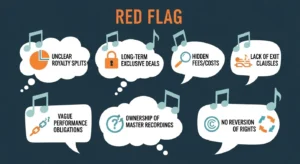
Before accepting a recording, management, publishing or distribution agreement, establish:
Which rights does the agreement cover?
Who owns or controls those rights?
How long does the agreement last?
Which territories are included?
What fees, commissions or deductions apply?
When are statements and payments due?
What happens when the agreement ends?
An independent lawyer can help interpret the terms. Another artist’s experience may reveal useful questions, but it does not establish what your own contract means.
Understanding Music Organisations
Artists should distinguish public copyright administration, collective rights management and professional representation. They serve different purposes.
The Copyright Office provides information and services relating to copyright, including registration and dispute mediation. Artists seeking mediation should check the Copyright Office’s application requirements and current fees.
GHAMRO and MUSIGA are also frequently discussed in Ghanaian music business conversations. Before relying on any organisation for a particular service, verify its current role, requirements and terms directly. Do not assume that union membership, copyright registration, distribution and worldwide royalty collection are interchangeable.
For any rights administrator, ask which rights it represents, which territories it covers, what information it needs and how distributions are calculated. Membership alone should not be treated as proof that every royalty is being collected.
How Ghanaian Musicians Earn Money
A music career can involve several income sources. Not every artist uses all of them, and the payment arrangements depend on the work and agreements involved.
Recorded music: income associated with streams, downloads and other uses of recordings.
Live performances: fees or agreed revenue shares from concerts, festivals and private events.
Songwriting and publishing: income connected with the underlying compositions.
Licensing: agreed use of music in advertising, film, television, games and other productions.
Brand partnerships: paid campaigns, endorsements and related work.
Direct sales: merchandise, recordings and other products sold to fans.
Licensing may involve both a composition and a recording. Treating the two as separate rights helps explain why more than one permission can be relevant to the same use.
The practical question is not only how much a song generates. It is who receives the money, what deductions apply and which agreement governs the payment. Keep secure copies of contracts, credits, contributor agreements and statements.
Promotion, Streaming and Audience Development
Promotion gives people a reason to listen, while distribution makes a recording available. An artist needs to understand both rather than expecting an uploaded song to find its audience automatically.
TikTok challenges can introduce a song to people who have never heard of the artist. Our guide to TikTok challenges in Ghana explains how those trends spread and where they fit into a wider promotion campaign.
For listeners, our Apple Music guide for Ghana explains how the service works locally.
A short burst of attention and a lasting audience are different goals. Planning should account for the full release, follow-up material, live work and communication with listeners, not just the first successful clip.
Awards and Industry Recognition
The Telecel Ghana Music Awards are a prominent annual celebration of Ghanaian music.
King Promise won Artiste of the Year at the 26th Telecel Ghana Music Awards in 2025. Black Sherif won the award at the 27th edition in 2026.
Winning an award does not reveal an artist’s earnings, booking fees or record-deal value. It does not establish a standard booking fee, streaming income or record-deal value.
What This Means for Artists and Listeners
For artists, understanding the Ghana music industry means connecting creative work with accurate credits, clear agreements and realistic business expectations.
For listeners, its history offers a way to explore beyond the latest hit. The connections between early guitar musicians, highlife performance, hiplife production and newer movements reveal an industry built by successive generations, not one platform or one star.

Discussion 0 comments
You must be logged in to write a comment.
Log In Sign UpNo comments yet. Be the first to start the conversation!