
Gold refining Ghana begins February 2026 as GoldBod and Gold Coast Refinery sign landmark deal to process 1 tonne weekly, keeping refining fees local.
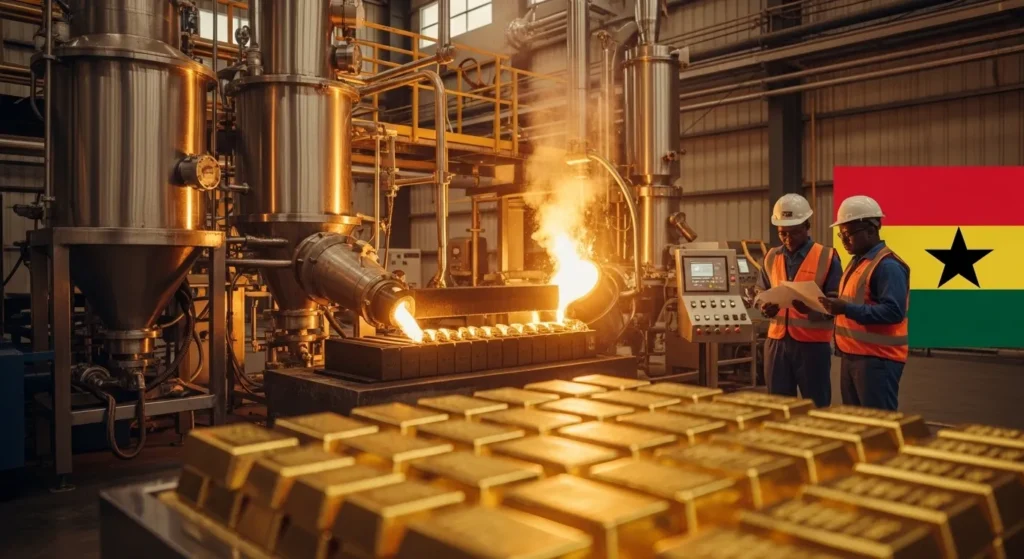
Ghana is transforming its gold trade. Starting February 1, 2026, the Ghana Gold Board GoldBod will refine one metric tonne of gold every week locally, ending nearly a century of exporting raw gold. This landmark agreement with Gold Coast Refinery marks President John Mahama’s vision to keep billions in value within Ghana’s economy.
Table of Contents
What Happened
On Tuesday, January 20, 2026, the Ghana Gold Board formally signed a major refining agreement with Gold Coast Refinery Limited at GoldBod’s Accra headquarters. GoldBod Chief Executive Officer Sammy Gyamfi called it a watershed moment and a turning point in how Ghana manages its mineral wealth.
Under the deal, GoldBod will refine 1,000 kilograms of gold weekly through Gold Coast Refinery, beginning February 1, 2026. The refined gold will meet minimum purity standards of 99.5 per cent, with capacity for higher international grades. Every gold bar refined will carry hallmarks from Gold Coast Refinery, Ghana Gold Board, Ghana Standards Authority, and the Bank of Ghana, ensuring transparency and traceability.
This marks a decisive strategic shift. Currently, approximately 99.9 per cent of Ghana’s gold exports leave the country in raw, unrefined form. Gyamfi described this as deeply worrying and emphasized it made no sense for Ghana to have refining capacity yet not use it.
Why This Matters in Ghana
Economic Impact and Value Retention
Gold refining Ghana represents massive financial significance for the nation. Historically, Ghana has paid millions of dollars annually in refining fees to facilities in Dubai, Switzerland, India, and Hong Kong. These charges will now remain within Ghana’s banking and financial system, strengthening local economic circulation.
Beyond refining fees, the agreement addresses Ghana’s undervaluation problem. Historically, Ghana relied on XRF assays, which do not accurately determine gold purity, leaving final valuation to foreign refineries. Now, Ghana will use fire assay the global gold standard to independently verify purity and value before export. “This agreement will put an end to the situation where we export gold and wait for refineries outside Ghana to tell us what our gold is worth,” Gyamfi stated.
Government Ownership and Revenue Streams
A critical feature. Gold Coast Refinery has granted the Republic of Ghana a 15 per cent free carried interest, held by GoldBod on behalf of the state. This makes the government a direct part owner, positioning Ghana to benefit from future dividends in addition to taxes.
Employment and Industrial Policy
Gold refining Ghana will operate 24 hours daily, aligned with President Mahama’s 24 hour economy agenda. This creates direct and indirect employment opportunities, increases tax revenues, and advances Ghana’s broader industrialisation strategy.
Immediate Context and Strategic Background
The Discovery That Sparked Action
In April 2025, GoldBod officials visited Gold Coast Refinery and discovered it was operating far below installed capacity despite being the largest refinery in the sub region. Gyamfi revealed the finding directly to President Mahama and the governing board, triggering technical audits and operational recommendations now being implemented.
“The state of affairs we witnessed was troubling,” Gyamfi explained, adding that President Mahama’s directive was clear. Ghana must move from extraction to full value optimization and true value addition.
Technical Partnerships and International Standards
To strengthen technical expertise and global market access, Rand Refinery of South Africa Africa’s only London Bullion Market Association LBMA accredited refinery will partner with Gold Coast Refinery. This partnership is crucial as Ghana works toward securing its own LBMA accreditation.
The arrangement ensures compliance with OECD and LBMA guidelines on responsible sourcing, sustainability, and traceability, supported by GoldBod’s track and trace system being launched.
Immediate Reactions and Next Steps – Government Vision
President Mahama tasked GoldBod with moving Ghana beyond raw extraction toward higher value processing. Gyamfi emphasized. “The President’s directive was unequivocal. Ghana must transition from being merely an extractor of resources to a country that captures full value through refining and value addition.”
Gyamfi stressed that Gold Coast Refinery is no longer viewed as an external contractor. “Through this agreement, Gold Coast Refinery becomes part of Ghana’s gold value chain in which the state has a direct stake,” he said.
Scaling Strategy
The initial phase will source gold from the artisanal and small scale mining sector, which GoldBod purchases and controls. However, engagements with the Chamber of Mines are already underway to expand participation to large scale mining companies.
“We must stop refining our gold in Europe while refineries in Ghana struggle. We have to start from somewhere,” Gyamfi stressed, signalling commitment to scaling beyond the one tonne weekly baseline.
What to Watch Next
Gold refining Ghana becomes operational on February 1, 2026. Key milestones to track include:
- Refinery ramp-up and capacity utilization during the first quarter
- Participation from large-scale mining companies and Chamber of Mines engagement outcomes
- Ghana’s progress toward LBMA accreditation for independent refinery status
- Implementation of the track-and-trace system and fire assay protocols
- Actual dollar retention figures and employment creation within six months
The agreement is framed as foundational for Ghana’s resource governance, combining industrial policy, transparency, and domestic value retention. Momentum behind this deal signals broader commitment to mineral value addition across the economy.
Quick Q&A
Q: When does gold refining Ghana start under this deal?
A: Refining operations begin February 1, 2026. GoldBod will process 1 tonne of gold weekly through Gold Coast Refinery.
Q: How much gold will be refined each week?
A: One metric tonne (1,000 kilograms) of gold weekly, meeting a minimum purity standard of 99.5 per cent.
Q: What’s the government’s stake in this agreement?
A: The Republic of Ghana, represented by GoldBod, holds a 15 per cent free carried interest in Gold Coast Refinery, making it a direct part-owner.
Q: Why is gold refining Ghana important for the economy?
A: Currently, 99.9 per cent of Ghana’s gold exports leave unrefined, with refining fees paid to foreign facilities. Local refining keeps millions in fees within Ghana’s economy and allows independent verification of gold value.
Q: Will gold refining Ghana use international standards?
A: Yes. The partnership with Rand Refinery of South Africa ensures compliance with London Bullion Market Association (LBMA) and OECD guidelines on responsible sourcing and traceability.
Q: How will this create jobs?
A: Gold refining Ghana will operate 24 hours daily, supporting President Mahama’s 24-hour economy agenda and creating direct and indirect employment opportunities in refining, logistics, and related services.
Check These:
Ghana mineral policy reforms and value addition initiatives.
Understanding gold export standards and international trade.




Pingback: Why Ghana Imports Energy In Spite Of Local Oil And Gas