
Rice Glut Crisis Explained and Why Farmers Are Struggling
Question:
What is the Rice Glut Crisis and why does it matter in Ghana?
Answer:
The Rice Glut Crisis refers to a market situation where rice supply exceeds demand, leaving farmers with unsold paddy and sharply reduced prices.
Rice production has increased.
Farmer incomes are collapsing.
The problem is not farming. It is the market.
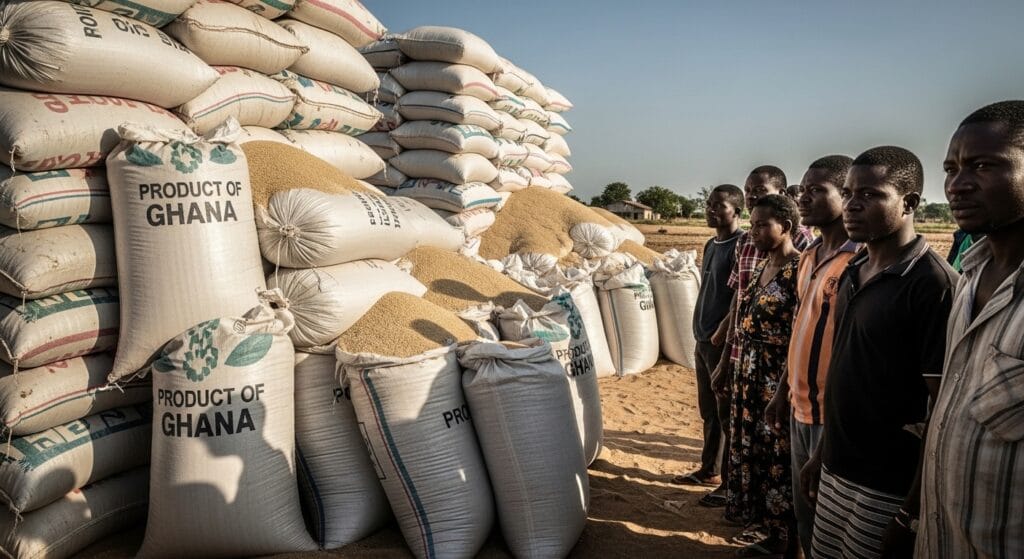
Table of Contents
Understanding the Rice Glut Crisis
The Rice Glut Crisis is a market condition, not a group or institution.
It happens when the volume of rice produced is higher than what buyers can absorb at profitable prices. When demand fails to keep pace with supply, prices fall and unsold paddy accumulates at farm level.
This is the situation Ghana is facing as of early 2026.
What Is Driving the Current Crisis
Several factors have combined to deepen the Rice Glut Crisis.
Domestic rice production for the 2025 to 2026 season is projected at about 900,000 metric tonnes, an increase of roughly 18 percent. Yet Ghana is still expected to import close to one million tonnes of rice this year.
According to the National Food Buffer Stock Company, more than 200,000 metric tonnes of paddy rice remain unsold from the previous harvest due to limited buyers.
In areas such as Asutsuare, farmers are storing rice in open fields, exposing it to spoilage and bushfires.
Price Collapse at Farm Level
The Rice Glut Crisis has triggered a sharp fall in farm gate prices.
In some production zones, prices for local rice have dropped by nearly 50 percent. These prices no longer cover fertilizer, labour, and transport costs.
While consumers may expect cheaper rice, the losses are concentrated among farmers who carry the highest risk.
Milling and Market Bottlenecks
One major contributor to the Rice Glut Crisis is limited milling capacity.
NAFCO traditionally procures milled rice, yet most of the surplus exists in raw paddy form. Many farmers lack the resources to mill their rice, while private millers are currently overwhelmed.
At the same time, imported rice continues to dominate urban markets, supported by better packaging and consistent supply.
Government and NAFCO Response in 2026
To prevent farmer bankruptcies, the government has introduced emergency measures.
Under a directive from John Dramani Mahama, the state released GH¢200 million to NAFCO to purchase excess rice stocks.
As of February 3, 2026, NAFCO licensed 14 companies to act as authorised agents to buy rice directly from farming communities and deliver it to buffer stock warehouses.
The Ministry of Food and Agriculture is also engaging private millers nationwide to buy paddy from farmers, process it, and supply finished rice to NAFCO.
Public institutions such as the School Feeding Programme and Free SHS have been directed to source all rice from local stocks.
Why This Crisis Matters Nationally
The Rice Glut Crisis goes beyond individual farmers.
If producers lose confidence, future planting declines and import dependence rises. Rural incomes weaken, youth exit agriculture, and food security becomes fragile.
This is the paradox Ghana now faces. Higher production is delivering lower incomes.
What Must Change Long Term
Emergency purchases alone will not resolve the Rice Glut Crisis.
Experts point to the need for expanded storage, reliable milling capacity, stronger market linkages, and better alignment between import policy and local harvest cycles.
Infrastructure such as agric enclave roads and mechanisation support are critical to long term stability.
Key Takeaways
• The Rice Glut Crisis is an oversupply market condition
• Over 200,000 tonnes of rice remain unsold
• Farm gate prices have collapsed
• Government and NAFCO have launched emergency interventions
• Structural reforms are needed to prevent repeat crises
Conclusion
The Rice Glut Crisis is not caused by farmers producing too much.
It is caused by markets failing to absorb what farmers produce. Fixing that gap is essential for Ghana’s food future.