

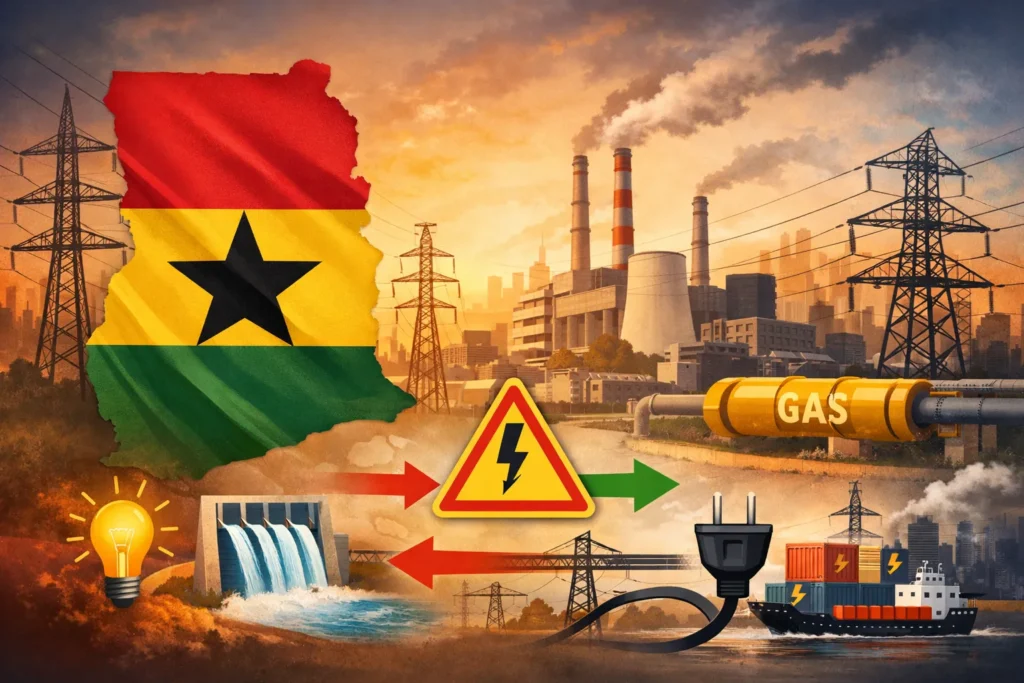
Quick Answer: Ghana produces crude oil, natural gas and electricity, but it still imports some energy because households and businesses need refined fuels, while power supply must balance hydro, thermal generation and regional grid connections. The Energy Commission reports that finished products account for more than 80 percent of petroleum consumption. Ghana can also import or export electricity through regional interconnections when operating conditions require it.
Ghana often exports power but occasionally must import electricity. Discover why Ghana imports energy despite having local oil and gas.
Question:
Why Ghana Imports Energy Even As A Power Exporter?
Answer:
Ghana imports energy because its power system and wider economy still rely heavily on imported fuels, seasonal hydro power, and regional trading rules, even though it exports electricity most of the time Energy Commission Ghana Energy Outlook 2025.
When rainfall is low, gas deliveries fall short, or demand grows faster than dependable capacity, Ghana turns to imported fuel or cross‑border power to avoid deeper load shedding and protect regional export contracts. At the same time, the country imports large volumes of petroleum products and LPG because local processing and infrastructure are not yet strong enough to meet demand on their own. These choices make sense in the short term but keep Ghana exposed to global prices, currency swings, and energy security risks.
Ghana is known as a power exporter and an oil and gas producer. Yet every few years, headlines, tariff hikes and “dumsor” fears remind people that the country still imports fuel and even electricity. So how can an energy‑rich country still rely on other nations to keep the lights on and engines running?
What You Need to Know
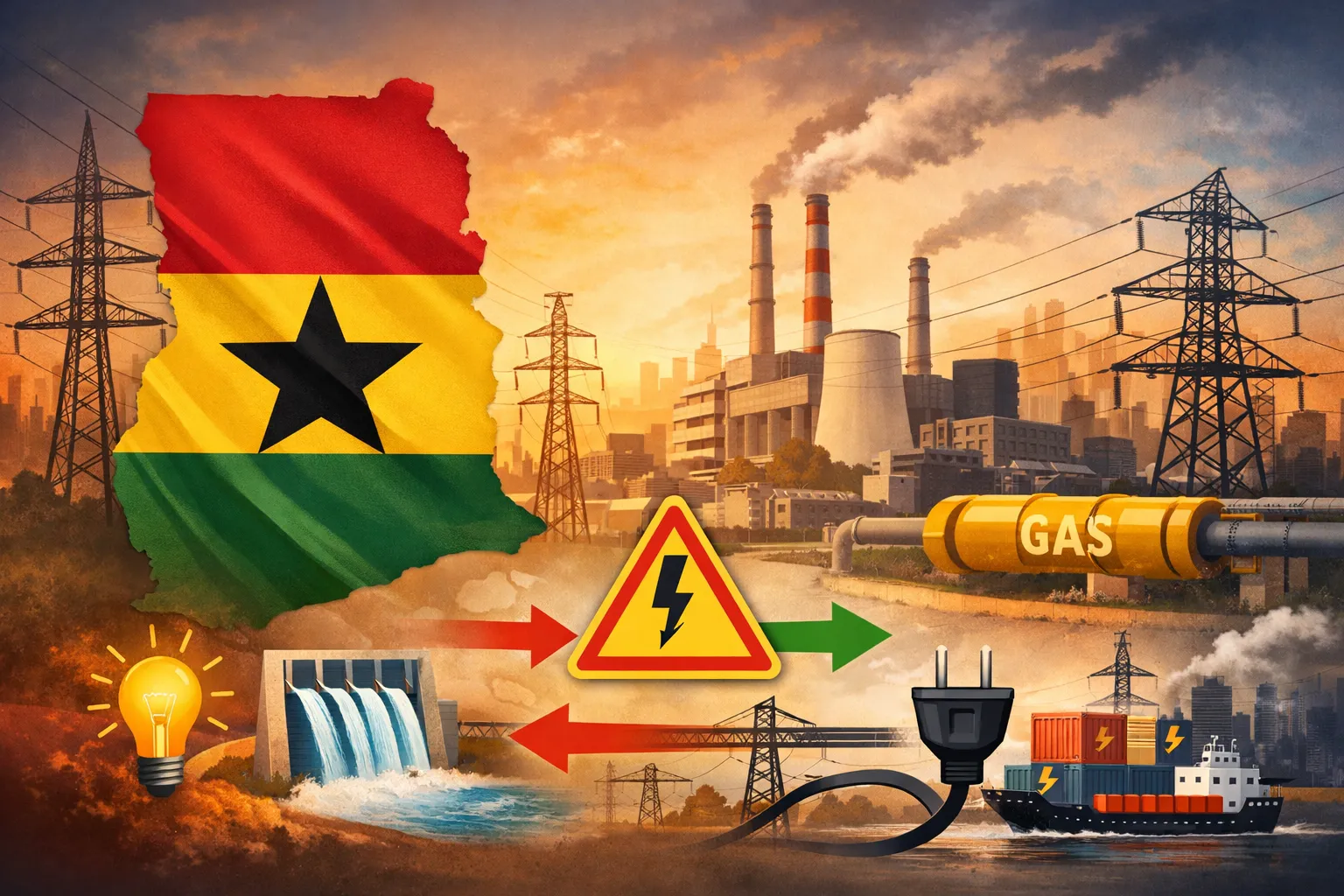
Ghana’s energy system is a mix of hydro dams, thermal plants running mainly on natural gas, smaller renewables, and a lot of imported petroleum products used in transport and cooking. According to recent outlooks, hydro, thermal and renewables provide most electricity, but traditional biomass and imported fossil fuels still dominate total energy use.
Electricity imports are now a small share of overall supply, with Ghana generally acting as a net exporter to countries such as Togo, Benin and Burkina Faso through the regional grid. However, official plans still anticipate the possibility of emergency imports when faults or fuel supply disruptions create short‑term capacity shortages.
Beyond the grid, Ghana remains heavily dependent on imported petroleum fuels, especially for transport and LPG for households, because refinery and storage capacity, pricing, and investment patterns have not fully kept up with demand. This mix means the country can be both an energy supplier to neighbours and a regular buyer of energy products on international markets at the same time.
How Ghana’s Energy System Works
Ghana’s power generation mix combines large hydro plants at Akosombo, Kpong and Bui with thermal plants located mostly in the south that burn natural gas and, when needed, liquid fuels such as light crude and diesel. Recent planning data show total installed capacity above dependable capacity, but actual usable output is constrained by water levels, fuel availability, plant maintenance and transmission bottlenecks.
Hydro power is cheap and clean but highly sensitive to rainfall and lake levels, so prolonged dry spells force a shift toward more thermal generation, which then depends on steady gas and fuel supplies. On the thermal side, domestic gas from fields like Jubilee, TEN and Sankofa now supplies a big share of fuel, but imports from Nigeria through the West African Gas Pipeline still play a strategic role.
Studies of Ghana’s gas sector highlight recurring issues such as contractual disputes, infrastructure limitations and payment delays, which can reduce or interrupt pipeline gas flows. When this happens, power producers must switch to more expensive liquid fuels or reduce output, creating the need for backup options including imports. At the same time, the wider energy balance shows traditional biomass and imported petroleum products forming most of the primary energy mix, underlining how important foreign fuel remains to everyday life.
Why Ghana Sometimes Imports Energy
Ghana sometimes imports electricity when domestic generation falls short of peak demand, especially in periods where hydro output is low and thermal plants cannot ramp up quickly enough. A 2024 analysis by the Institute for Energy Security, for example, found that shortfalls of around 700 MW at peak led Ghana to import power from Côte d’Ivoire over several weeks to stabilise supply.
Fuel supply problems also push Ghana toward imports, both for power and for the broader economy. When gas from Nigeria or local fields is insufficient or delayed, thermal plants either pay more for liquid fuels or reduce output, creating gaps that have to be filled by imported electricity or by cutting exports so more power stays at home.
Even outside the grid, Ghana imports large quantities of refined petroleum products because its refining and storage systems do not yet fully replace international supply. Research suggests that this pattern of importing energy can delay the expansion of local renewables because governments prioritise managing immediate fuel obligations over investing in new clean capacity.
Another reason Ghana imports energy lies in how regional power markets work. Through the West African Power Pool and bilateral deals, it can make commercial sense at certain times to import cheaper off‑peak electricity or tap neighbours during emergencies instead of building and maintaining extra local plants that would sit idle most of the year.
How Regional Power Trade Fits In
Ghana is a key member of the West African Power Pool, a regional initiative that connects grids and encourages countries to trade electricity to improve reliability and cut costs. Interconnection lines link Ghana with Côte d’Ivoire, Togo and Burkina Faso, allowing power to flow in both directions depending on who has surplus and who faces a shortage.
A World Bank‑backed project is reinforcing Ghana–Côte d’Ivoire interconnections and other lines to support more flexible regional power trade in the years ahead. This means Ghana can sell power when its dams and plants are performing well, but also import when domestic conditions tighten, all within agreed technical and commercial frameworks.
Regional trade is not only about money; it also supports political and economic relationships with neighbours that rely on Ghana’s exports during their own shortages. Cutting off exports or avoiding imports at all costs could damage this cooperation and reduce incentives for joint investments that ultimately improve reliability for everyone.
For Ghanaians, the key point is that imports within this system are not automatically a sign of weakness; they are part of how a connected region manages shared risks. The real concern is whether Ghana’s own system is strong enough that imports remain a choice and not a constant emergency.
Why It Matters in Ghana
Energy imports show up directly in the cost of living through electricity tariffs and fuel prices, because imported gas and petroleum products are paid for in foreign currency and exposed to global price swings. When the cedi weakens or international prices rise, utilities and oil marketers face higher costs, which often translate into higher bills for homes and businesses.
Unreliable domestic generation combined with dependence on imports also feeds energy poverty and inequality. Studies on Ghana’s energy poverty note that high prices and unstable access hurt low‑income households the most, affecting education, health and opportunities, especially outside major cities.
For industry and jobs, frequent power constraints and uncertain fuel costs can limit Ghana’s ability to move from exporting raw materials to adding value at home, a problem already visible in sectors like agriculture and mining. Manufacturers need stable, affordable power to compete, so any system that relies too heavily on imported energy under fragile contracts can hold back broader economic transformation.
There is also a climate and future‑readiness angle. Research indicates that heavy reliance on fossil fuel imports makes it harder for Ghana to meet climate goals and build a resilient food system, while investments in renewables can reduce long‑term risks from both climate change and fuel price shocks.
Common Questions Answered
If Ghana exports power, why does it still import electricity sometimes?
Ghana exports power when its hydro dams and thermal plants have enough dependable capacity, but in dry periods, during faults, or when demand peaks above available output, it imports from neighbours like Côte d’Ivoire to cover the gap.
Does importing energy mean Ghana is failing?
Importing some energy is normal for many countries, especially in interconnected regions, but persistent dependence combined with fragile domestic infrastructure is a warning sign that long‑term investments and regulation need to improve.
How much of Ghana’s energy is imported?
Recent studies show that traditional biomass still provides most of Ghana’s primary energy, while crude oil and petroleum products account for over a quarter, much of it imported, and electricity remains a smaller portion of the total mix. Electricity imports themselves are now a small fraction of supply, though emergency power can still be pulled in when needed.
Will Ghana ever stop importing energy?
It is unlikely that Ghana will stop importing energy entirely because regional trade and some fuel imports can be efficient and strategic, but the goal is to reduce risky dependence by growing domestic renewables, strengthening gas supply, and improving efficiency.
What role can renewables play in reducing imports?
Ghana has strong potential in hydropower, solar, wind and bioenergy, and evidence suggests that expanding these sources alongside better policies and finance can cut fossil fuel imports over time and improve both environmental and energy security outcomes.
Exam Quick Notes
Four reasons why Ghana sometimes imports energy
- Domestic electricity is not enough at peak times
When demand is high and generation is low, such as daily shortfalls of about 700 MW in 2024, Ghana imports power from Côte d’Ivoire to cover the gap and reduce “dumsor”. - Hydro power depends on rainfall
In years or seasons with low rainfall, Akosombo, Kpong and Bui produce less power, so Ghana relies more on thermal plants and sometimes imported electricity or fuel. - Gas and fuel supply problems
Ghana does not always get enough gas from domestic fields or from Nigeria through the West African Gas Pipeline, so plants switch to more expensive liquid fuels or the country imports power to keep the lights on. - Regional trade and cost reasons
Through the West African Power Pool, it can be cheaper or more reliable at certain times to import electricity from neighbours instead of running all local plants or building extra capacity that will not be used every day.
Four effects of energy imports on Ghana’s economy
- Higher light bills and fuel prices
Imported gas and petroleum products are paid for in foreign currency, so when prices or the cedi move, electricity tariffs and pump prices often go up for homes and businesses. - Pressure on government budget and debts
Paying for imported fuel and emergency power can add to energy sector debts and subsidies, which then put pressure on the national budget and can slow other spending like education and health. - Slower industrial and job growth
Unreliable power and expensive imported energy make it harder for factories and small businesses to plan, which can reduce investment, limit production, and slow job creation. - Delayed investment in local renewables
When a lot of money goes into buying fuel and paying old energy debts, there is less left to invest in solar, wind and other local sources that could reduce imports in the future.
Key Takeaways
- Ghana is usually a net electricity exporter but still relies heavily on imported fuels, gas and occasional power from neighbours.
- Shortfalls in hydro output, gas supply disruptions and faster demand growth than dependable capacity drive many of the moments when Ghana turns to imports.
- Regional trade through the West African Power Pool allows Ghana to sell power when it has surplus and buy power when it faces shortages, making imports part of a planned system rather than a pure emergency move.
- Heavy dependence on imported energy exposes households and businesses to global price shocks, currency risk and energy poverty, affecting everything from small shops to food security.
- Scaling up renewables, strengthening gas supply, improving efficiency and reforming sector finances are key to turning energy imports into a manageable tool instead of a permanent vulnerability.
Related: the practical side of living in Ghana.


Discussion 0 comments
You must be logged in to write a comment.
Log In Sign UpNo comments yet. Be the first to start the conversation!