Ghana Card registration guide 2026: where to register, documents you need, how the new fees work, plus link to the full Ghana Card fees breakdown.
Question:
How do you register for the Ghana Card in 2026, where can you go, what documents do you need, and how do the new fees affect the process?
Answer:
To register for the Ghana Card in 2026 you must visit an NIA registration point with your documents, fill a form, capture your biometrics and then wait for your card to be printed or issued later. Standard district offices now charge GH₵30 for some first-time adult registrations and higher fees for replacement and updates, while special premium and institutional centres cost more; you can see the full fee list in Debesties’ Ghana Card Fees 2026 Breakdown anchor article.
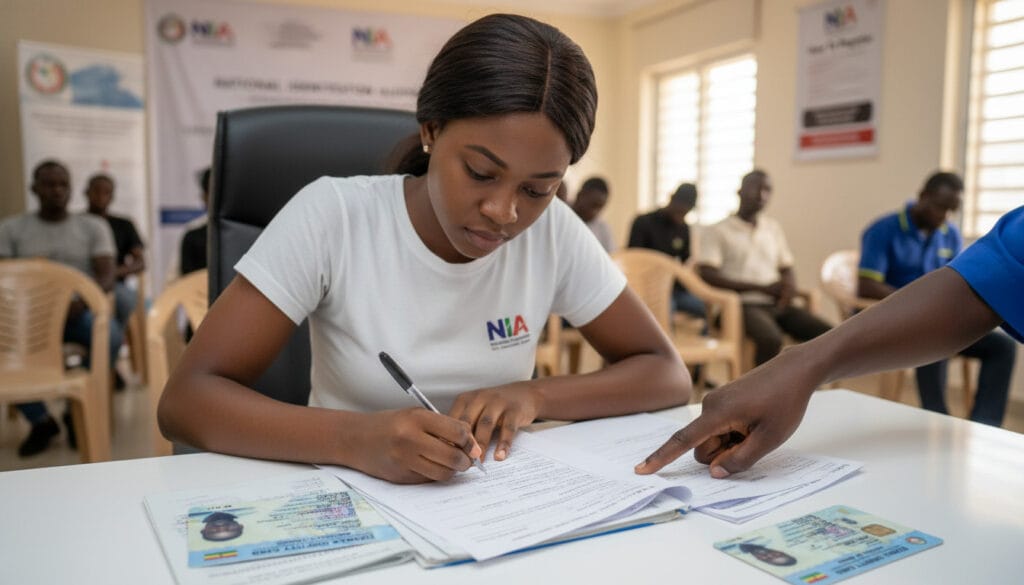
The Ghana Card now controls almost everything from SIM registration and bank accounts to exams and government services in Ghana. With new fees in place from February 2026, it is more important than ever to know where to go, what to carry and how to avoid extra charges when you register.
Table of Contents
What You Need To Know Before You Register
From 2 February 2026, the National Identification Authority is rolling out revised fees and procedures for Ghana Card services. District and regional offices remain the main places for standard registration, while premium centres and institutional exercises serve those who want faster service or group registration for staff and students.
If you are 25 years and above registering at a standard centre, you should now expect to pay a first-time registration fee around GH₵30, while replacement of a lost or damaged card has climbed sharply and updates with card reprint also carry charges. Younger applicants and renewals still enjoy some free services, but everybody must follow the same biometric process and bring proper documentation. For the exact fees by age, service type and location, read Ghana Card Fees 2026 Breakdown, which carries the full official table.
Where To Register For The Ghana Card In 2026
Most Ghanaians will register at NIA district registration offices, which operate on weekdays and handle first-time enrolment, renewals, replacements and updates. Regional offices handle complex cases and may also run special outreach programmes to markets, schools and communities when the NIA launches targeted exercises. These standard points are cheaper but can get crowded, so it helps to arrive early and prepare all documents before you go.
For those who prefer shorter queues and air-conditioned halls, NIA runs premium registration centres in some cities where people can pay higher fees for faster and more comfortable service. Businesses, universities and large organisations can also arrange institutional or on-site registration, where NIA teams visit their premises to enrol staff and students for a negotiated fee structure. Ghanaians abroad register through embassy-linked or special diaspora exercises, which charge cedi equivalents of fixed dollar amounts for first-time issuance, replacement and renewal.
Documents You Need And How The Process Works
To register successfully, you must prove that you are a Ghanaian and confirm your personal details. The most common paths are: presenting a birth certificate, a valid Ghanaian passport, or having two existing Ghana Card holders serve as guarantors if you lack formal documents. Some applicants may also use a certificate of acquired citizenship or other legal documents, depending on NIA rules.
At the centre, staff will ask you to complete or confirm a registration form with your name, date of birth, hometown, residential address, parents’ details and other bio data. You will then go through biometric capture: fingerprints, facial image and sometimes iris, followed by a final confirmation screen where you must check spellings and details carefully before submission. Depending on the centre, your card can be printed immediately or scheduled for later collection; keeping your receipt or slip safely is essential so you can claim the card without stress.
How The New Fees Change Your Registration Decisions
The new NIA fee structure makes losing your card far more expensive, with replacement in Ghana now around GH₵200 and some updates with card reprint also charged. This means you should treat your Ghana Card like a passport: keep it in a safe wallet, avoid leaving it with third parties, and use photocopies or digital scans whenever possible rather than moving with the original everywhere. For first-time adult registration, the new GH₵30 fee at standard centres is moderate but still worth planning into your monthly budget so you are not caught off guard.
If you are under 25, you may still enjoy free first-time issuance and free renewals, but you will pay heavily if you lose the card and need a replacement. For diaspora Ghanaians, the dollar-linked fees for issuance, renewal and replacement mean that timing registration during a trip home may be cheaper than relying only on special embassy exercises. Because premium and institutional centres cost more, it makes sense to use them only when you truly need speed or group convenience and to use standard offices for regular personal registration.
Why Ghana Card Registration Still Matters In Ghana
Despite the higher fees, registering for the Ghana Card is not optional if you want full access to Ghana’s financial and digital systems. Banks, mobile money operators, exam bodies, revenue agencies and many government departments now use the Ghana Card as a primary ID for opening accounts, applying for services and verifying identity. Without a valid card, citizens can face hurdles in simple tasks like registering a SIM card, applying for social programmes or boarding some local flights.
The revised charges also raise an important question about inclusion and fairness: how can Ghana fund a modern identity system while ensuring that poorer citizens are not priced out of basic documentation? This is why clear information on where to register, how much to pay and what to carry is crucial, and why Debesties’ fee breakdown anchor plus this registration guide work together to help readers make informed choices.
Key Takeaways
- In 2026, you register for the Ghana Card mainly at NIA district or regional offices, with premium and institutional centres as paid options.
- Adults 25+ may pay around GH₵30 for first-time registration at standard centres, while replacement of lost or damaged cards now costs about GH₵200.
- You need strong proof of citizenship, such as a birth certificate, passport or guarantors, and must carefully confirm your details during biometric capture.
- New fees make it vital to protect your card, avoid careless loss and choose standard centres over premium ones unless you truly need faster service.
- The Ghana Card remains a gateway to banking, SIM registration and public services, so registering early and correctly is essential for life in Ghana’s digital economy.