

Quick Answer: Ghana can work well for remote travel when you plan entry status, accommodation, connectivity and backup power before arrival. The official eVisa portal asks applicants to check eligibility by nationality and travel purpose. Do not assume a visitor visa permits local employment. If your arrangement involves work in Ghana, check the Ghana Immigration Service work permit guidance before making commitments.
Starting your journey as a digital nomad Ghana remote worker in 2026 requires clear planning to navigate the local infrastructure successfully. The country has solidified its position as West Africa’s premier hub for remote workers. Offering an affordable cost of living, a booming tech ecosystem, and unparalleled cultural warmth, living here is highly rewarding. However, navigating infrastructure like internet speeds and power backups requires a strategic approach.
This definitive 2026 guide provides the exact data, costs, and steps you need to successfully work and travel in Ghana.
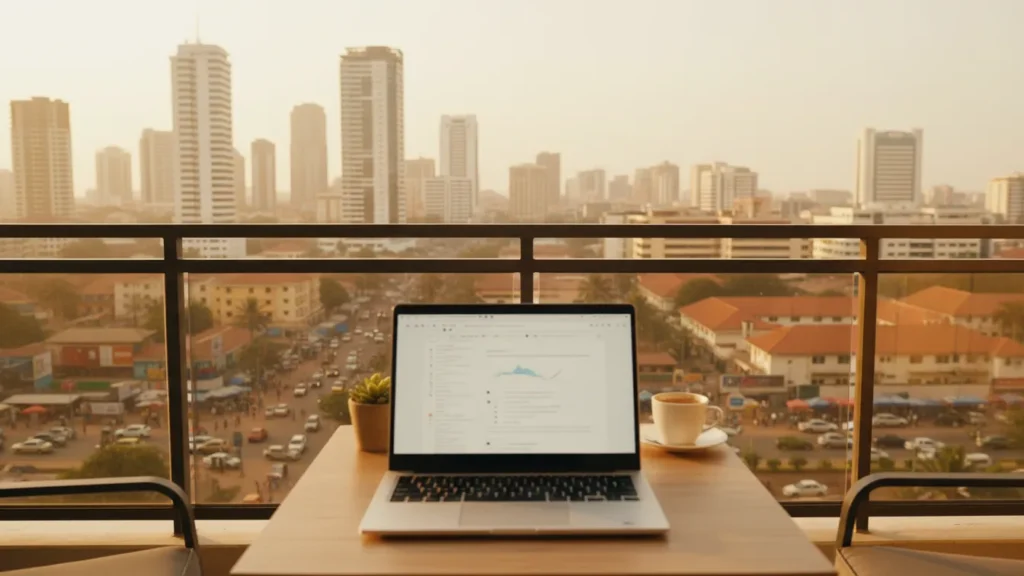
Four Planning Checks for a Ghana Remote Work Base
When calculating the cost of living in Accra for expats, planning ahead ensures your currency goes further. Use this structured roadmap to plan your baseline expenses:
- Est. Monthly Cost: $750 - $1,000 / mo (Budget) | $1,800 - $2,500 / mo (Luxury)
- Average Rent (1BR): $400 - $600 / mo (Budget) | $1,200 - $1,800 / mo (Luxury)
- Top Neighborhood: Osu, East Legon (Budget) | Cantonments, Airport Residential (Luxury)
- Primary Internet: MTN 4G/5G Router (Budget) | Fiber Optic + Starlink Backup (Luxury)
1. Visas and Entry Requirements for a Digital Nomad Ghana Trip
The status of the digital nomad visa Ghana 2026 platform is currently under review by local authorities, meaning temporary travelers must use existing digital systems to secure entry.
- The eVisa Portal: Do not rely on mail-in embassy applications. Most nationalities must apply via the official Ghana Immigration Service eVisa Portal 1 to 2 months before departure.
- Duration and Extensions: Standard tourist visas grant 60 days upon entry. To extend your stay up to 90 or 180 days, you must visit the Immigration Headquarters in Accra or apply for a temporary residence permit.
- Mandatory Health Entry: You will be denied entry without a physical Yellow Fever vaccination certificate. Carry your physical Yellow Card.
2. Navigating Internet and Power Outages in Ghana
The biggest challenge for any remote worker in Ghana is maintaining uptime. Intermittent power outages, locally known as Dumsor, occur occasionally. You must build redundancy into your setup.
Primary: Fiber or Starlink, then MTN 5G MiFi, with an inverter or generator for backup
Mobile Networks and Internet Speeds
- MTN Ghana: The undisputed market leader. 5G coverage is widely available across central Accra. Speeds range from 40 to 150 Mbps download. Cost is approximately $15 to $25 for 50GB.
- Telecel Ghana (Formerly Vodafone): Reliable fiber-to-the-home provider in premium neighborhoods. Speeds range from 50 to 100 Mbps on fixed fiber.
- Starlink: Fully operational in Ghana for 2026. This is the ultimate tool for nomads traveling outside Accra to coastal regions like Busua or Cape Coast.
The Power Backup Rule
When booking an Airbnb or signing a short-term lease, explicitly ask the host: "Does the building have an automatic standby generator or solar inverter system, and is it included in the rent price?" Do not book a place without verified power backup.
3. Best Accra Neighborhoods for a Digital Nomad Ghana Lifestyle
Accra is a sprawling city; traffic can eat up hours of your day. Choose your base wisely based on your lifestyle needs:
- Osu and Labone (The Cultural Heart): Best for walkable cafes, nightlife, and networking. Highly social but can be noisy.
- Airport Residential and Cantonments (The Corporate Safe-Havens): Best for premium apartments, maximum security, and flawless fiber internet.
- East Legon (The Modern Suburb): Best for trendy restaurants, shopping malls, and upscale local living.
4. Best Coworking Spaces Accra has to offer
If you need to escape your apartment, Accra features a tight-knit network of work-friendly spaces:
- buro. (Osu): Biophilic, modern design with exceptional community networking, indoor/outdoor seating, and flawless backup power.
- Impact Hub Accra (Osu): The epicenter for local tech startups. Best for entrepreneurs looking to network within the West African market.
- BaseCamp Initiative (East Legon): A quiet, highly productive environment favored by creative freelancers.
- Work-Friendly Cafes: Kukun (Osu), Cafe Kwae (Airport), and Vidya Bookstore Cafe (Labone) all offer solid Wi-Fi and power outlets.
5. Mobile Money (MoMo) and Financial Survival
Ghana is rapidly moving toward a cashless digital economy driven by Mobile Money. Credit cards are accepted at major supermarkets, but daily life runs on telecom wallets.
How to Set Up MoMo in Your First 48 Hours:
- Buy a SIM: Purchase an MTN or Telecel SIM card at Kotoka International Airport or an official service center. You must register it using your passport.
- Activate MoMo: Request the agent to activate Mobile Money on your account.
- Fund Your Wallet: Link your foreign debit card via apps like Sendwave, Wise, or Remitly to transfer funds directly into your Ghanaian MoMo wallet.
- Usage: Use your MoMo wallet to pay for everything from Uber/Bolt rides to street food and utility bills.
6. Comprehensive Pre-Arrival Checklist
- Health: Yellow Fever card, malaria prophylaxis, and high-DEET mosquito repellent.
- Hardware: Unlocked smartphone, a 20,000mAh+ power bank, and a backup universal travel adapter.
- Finance: At least $200 in crisp, uncreased USD cash bills for emergency exchange.
- Software: Download Uber, Bolt, and Yango for city transport; download Google Maps for offline use.



Discussion 0 comments
You must be logged in to write a comment.
Log In Sign UpNo comments yet. Be the first to start the conversation!