Trump Khamenei death claim after U.S. and Israeli strikes is shaking markets; here is what a key source says and how it could affect Ghana and fuel prices.
Question:
What does Trump’s Khamenei death claim, backed by reports of an Israeli airstrike, really mean, and how could it affect Ghana?
Answer:
Trump Khamenei death claims, supported by a U.S.‑briefed source who says an Israeli airstrike killed Iran’s Supreme Leader, signal a dangerous new phase that can move oil prices, the cedi and daily costs in Ghana.
The world woke up to a dramatic message from the White House.
President Donald Trump says Iran’s Supreme Leader is dead after joint U.S. and Israeli strikes, and a source briefed on the operation has told U.S. public radio that an Israeli airstrike killed him.
For Ghanaians, the question is simple: how will this shake our pockets and our peace of mind.
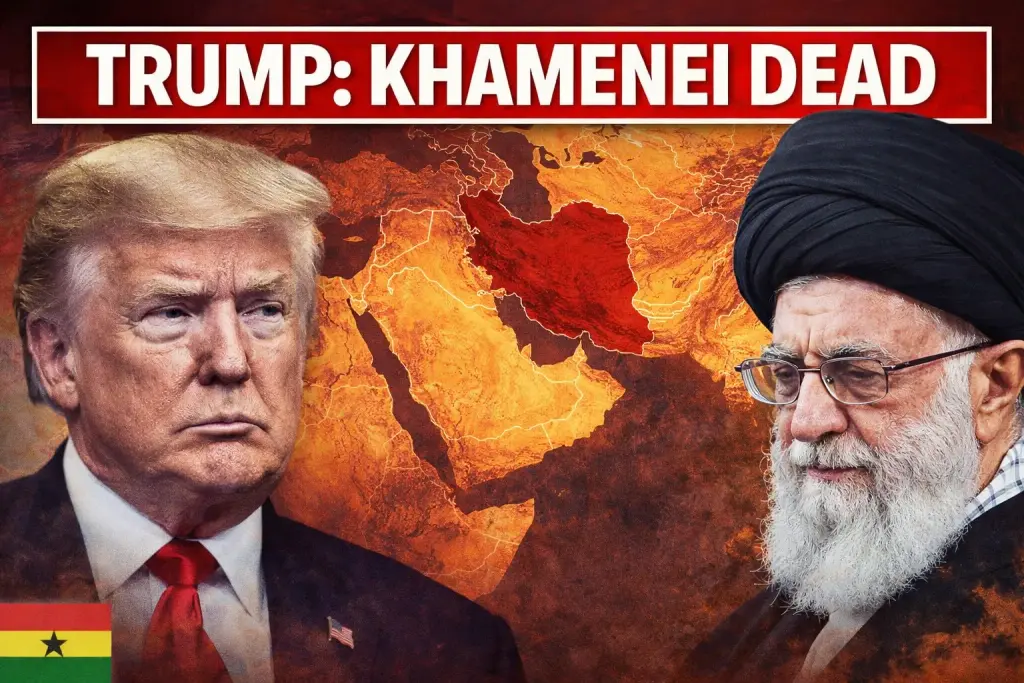
Table of Contents
What happened in Trump’s Khamenei death claim
Trump released a long statement on his own social platform claiming that Ayatollah Ali Khamenei, the Supreme Leader of Iran, “is dead” after targeted strikes which he says were carried out with Israel.
In the post he calls Khamenei “one of the most evil people in History” and blames him and his “gang of bloodthirsty thugs” for deaths and suffering in Iran, the United States and many other countries.
Trump also boasts that Khamenei “was unable to avoid our Intelligence and Highly Sophisticated Tracking Systems” and says there was nothing he or other leaders killed alongside him could do to escape.
He frames the operation as the “single greatest chance for the Iranian people to take back their Country” and claims parts of Iran’s security forces now want immunity rather than more fighting.
The president ends by promising that “heavy and pinpoint bombing” will continue throughout the week or “as long as necessary” to reach what he calls peace in the Middle East and even the world.
His wording leaves little room for doubt about his intentions, which is why the message has become a central moment in this crisis.
What is actually confirmed so far
A source who was briefed on the U.S. and Israeli attacks has told U.S. public radio that an Israeli airstrike killed Khamenei, ending his long rule at the top of Iran’s system, and that the strike was part of a wider operation against Iranian leadership and military sites.
On top of that, U.S. and Israeli officials are briefing that they believe he is dead, which is why many international outlets now treat his death as highly likely rather than just a rumour.
At the same time, information from inside Iran is still tightly controlled, and official channels in Tehran have been cautious or slow to confirm what exactly happened and who will take over.
Analysts warn that the power vacuum at the top of Iran’s system could trigger internal struggles, new proxy fights and a wave of retaliation in parts of the Middle East where Iran has influence.
For Ghanaian readers, it is important to separate what Trump is claiming, what a named source says about the airstrike and what independent reporters can verify on the ground, since propaganda and information warfare are also part of this conflict.
The facts will keep evolving as more evidence appears, but the immediate impact on global markets and security calculations has already begun.
Why the Trump Khamenei death claim matters in Ghana
Iran and the Gulf region play a central role in world oil supply, so any heavy fighting or attacks on leadership there can push crude prices up quickly, just as previous strikes did in the past.
Ghana imports most of its fuel, which means higher global oil prices usually show up at the pump through increased petrol and diesel prices, higher transport fares and more expensive food.
When fuel costs rise, trotro fares, delivery fees and market prices often follow, and that pressure can weaken the cedi further as more foreign currency goes to pay for imports.
For Ghanaian businesses that depend on generators and long distance transport, a prolonged spike in prices could squeeze already tight margins and slow down growth.
There is also a diaspora angle, since many Ghanaians live, work or study in the United States, Europe and parts of the Middle East where security responses and travel rules may change as the crisis deepens.
For creators, traders and digital workers, instability in the Middle East often translates into volatility in global markets, which can affect everything from remittances to online incomes.
How social media is spreading Trump’s message
Short clips of Trump saying “Khamenei is dead” in interviews and news hits are already trending on platforms like YouTube, TikTok and Reels, often pushed through attention‑grabbing thumbnails and titles.
Screenshots of his statement and quick reaction videos are circulating widely, sometimes cut in a way that removes context about verification and the risk of wider war.
For many Ghanaians, the first contact with this story is not a detailed article but a dramatic video or image that appears in a WhatsApp status or TikTok feed.
That is why slow, calm explainers that prioritise facts over drama are important, so people can understand what is happening without panic.
Debesties can add value by focusing on how these events affect Ghana and by speaking in clear, simple language rather than repeating every rumour or partisan take.
Pointing readers to practical implications instead of only viral soundbites helps build trust in a noisy information environment.
What Ghanaians should watch next after the Trump Khamenei death claim
First, watch for firm on‑the‑record confirmation or denial from credible Iranian and international bodies, since that will shape whether this moment leads to a negotiated shift or a drawn out war.
Second, follow updates on global oil prices and local fuel price forecasts, because those will give early signs of possible increases at Ghanaian pumps.
Third, keep an eye on statements from ECOWAS, the African Union and Ghanaian authorities, especially if travel or security advisories change for Ghanaians abroad.
Finally, be cautious with sensational posts on social media that promise secret information or extreme claims without naming any sources, since these often turn out to be misleading or false.
Ghana’s position outside the core conflict gives the country some distance, but the economic and social ripples from a major shift in Iran will still be felt, which makes clear information essential.
By following measured updates and trusted platforms, readers can stay informed without unnecessary fear.
Key Takeaways:
- Ghanaians should track official confirmations, fuel price updates and credible news, while treating viral posts without sources with caution.
- Trump Khamenei death claims mark a new and dangerous phase in the Iran crisis after joint U.S. and Israeli strikes, with a briefed source saying an Israeli airstrike killed him.
- Oil markets and global investors are watching closely, since any sustained conflict around Iran can push prices higher.
- Ghana relies on imported fuel, so a rise in global prices can raise transport fares, food costs and pressure on the cedi.
- Social media is driving the story with dramatic clips and screenshots, which makes calm, fact‑checked explainers more important than ever.