

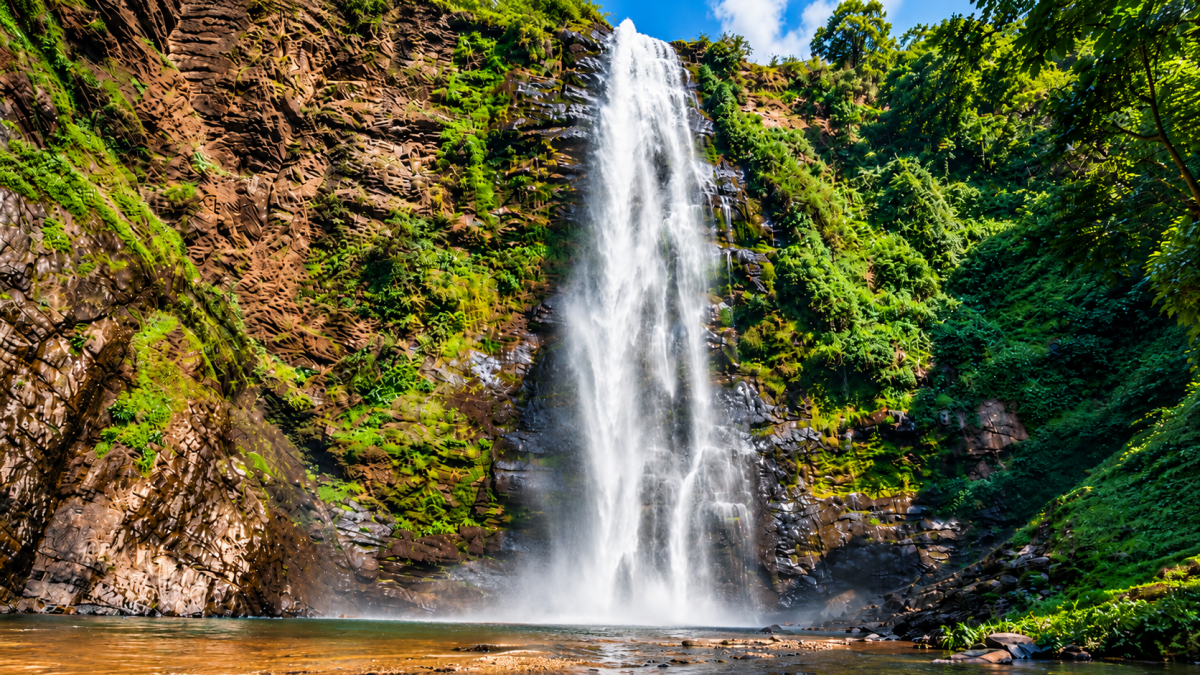
Wli Waterfalls sits in the Hohoe area of Ghana's Volta Region, about 20 km from Hohoe town, and both Wikipedia and Visit Ghana describe it as the tallest waterfall in West Africa. There are two falls: an easy lower fall you can walk to in about half an hour, and an upper fall that needs a licensed guide and most of a morning.
This guide gives the official entry fees, how to get there from Accra, how long each hike takes and when to go. Where sources disagree, it says so.
Wli Waterfalls at a glance
- Where: Wli, Hohoe Municipality, Volta Region, about 20 km from Hohoe town.
- From Accra: sources give roughly 230 to 280 km. Plan on a 4 to 5 hour drive.
- Lower falls: about 2.2 km from the reception on level ground, 30 to 40 minutes.
- Upper falls: a steep hike of 3 to 4 hours with a licensed guide, on a short or a long route.
- Entry, lower falls: GH₵25 for Ghanaian adults and GH₵60 for non-Ghanaian adults on the official fee list.
- Best time: the falls run strongest from about April to October. The dry season is easier for hiking.
Getting to Wli from Accra
By car, one 2025 guide puts the trip at about 230 km and 4 to 5 hours. Wikipedia and Visit Ghana give about 280 km, so allow for the longer figure and for traffic out of Accra.
Without a car, take a bus or shared taxi from Accra to Hohoe, then a taxi or motorbike for the last 20 minutes or so. From Hohoe, Visit Ghana describes driving east and turning right at Lipke Bakwa, with Wli about 3 km from the turn. Cars cannot drive up to the falls themselves. The official tourism site says motorbikes can carry visitors to the lower falls.
The same 2025 guide advises sharing a taxi for the day or hiring a car rather than relying on tro-tros for the longer legs outside Accra, because of breakdowns on those routes.
The lower falls: the easy walk
The lower falls are the one most visitors do. The official site rates the walk as easy: about 2.2 km from the reception area on level ground, taking 30 to 40 minutes. It runs through the Agumatsa Wildlife Sanctuary, which is why there is an entry fee and why rubbish should go back out with you.
Visit Ghana's listing says there is a pool at the base of the falls where visitors can swim, so bring a swimsuit and a towel. Ask your guide on the day whether the water level makes it sensible.
A colony of fruit bats roosts on the cliffs near the lower falls. Visit Ghana notes that a visit in the late afternoon may show thousands of them leaving the cliffs to feed.
The upper falls: the hard hike
The upper falls are a different day out. The official site rates the hike as medium and says licensed guides are mandatory. It gives 3 to 4 hours, with a steep short route and a longer loop with viewpoints. Visit Ghana describes it as steep and challenging, about 4 hours. Wikipedia gives the upper fall as roughly 80 metres.
Wear hiking boots and long trousers, carry water and snacks, and confirm the route with the Tourism Office before you set off. Visit Ghana says the upper falls hike is usually too slippery and dangerous during the rainiest months, so ask at the office before committing to it in the wet season.
Entry fees
These are the figures on the official Wli tourism site. The page is undated, with a 2023 copyright footer, so confirm at the gate or by email before you plan a budget around them.
- Lower falls, Ghanaians: adult GH₵25, tertiary student GH₵15, school pupils and children GH₵7. A family pack of five is GH₵60.
- Lower falls, non-Ghanaians: adult GH₵60, student GH₵40, children GH₵25.
- Upper falls, Ghanaian adults and students: GH₵60 on the short route and GH₵70 on the long route.
- Upper falls, non-Ghanaian adults: GH₵80 on the short route and GH₵90 on the long route.
- Commercial photography: GH₵200 for a still camera and GH₵300 for video.
Group rates apply from 40 people. The official site does not list opening hours. One tourism listing gives 8 am to 5 pm daily, so call ahead if you are driving a long way.
The best time to visit
Wikipedia says the water volume peaks in the rainy season, May to October, and that the dry season from November to March has clearer water and easier access. Visit Ghana says the falls are most impressive from April to October. The 2025 guide agrees the falls are at full force in the wet months, and notes that November to March is more pleasant for hiking but the flow is slower.
In practice: come in the wet season for the falls, in the dry season for the hike, and expect muddy trails in between. The same guide suggests a Sunday morning to avoid the after-church crowds.
What to bring
- Hiking boots, especially for the upper falls or in the rainy season.
- A swimsuit and a quick-dry towel, and a waterproof bag for your phone.
- Water and snacks, and a bag to carry all your rubbish out.
- Cash for the fees, snacks and souvenirs, and a tip for your guide.
Staying near Wli and what to add
Visit Ghana lists homestays, camping, two hotels in Wli and mostly budget lodges in the area. Nearby you can add Mount Afadja (Afadjato) and Tagbo Falls around Liati Wote, and the Tafi Atome Monkey Sanctuary. The 2025 guide also mentions the Amedzofe canopy walk, about an hour's drive away.
For the rest of the country, our guide to the best places to visit across the regions shows where the Volta Region fits, and the Ada Foah weekend guide covers the Volta's coast.
Stay connected
Data helps for maps, mobile money and booking a taxi back from Hohoe. An eSIM is the simplest way to have it from the moment you land.



Discussion 0 comments
You must be logged in to write a comment.
Log In Sign UpNo comments yet. Be the first to start the conversation!